
China's Breakthrough in Simulating Earth-Scale Societies with One Billion AI Agents
Light Society

ONE BILLION AGENTS!
In a significant advance for computational social science and artificial intelligence, a team of researchers primarily from Chinese institutions has unveiled Light Society, an agent-based simulation framework capable of modeling human-like societies at planetary scale. The system powers simulations involving over one billion AI agents, each endowed with realistic personalities, memory, beliefs, goals, and decision-making capabilities derived from large language models (LLMs).
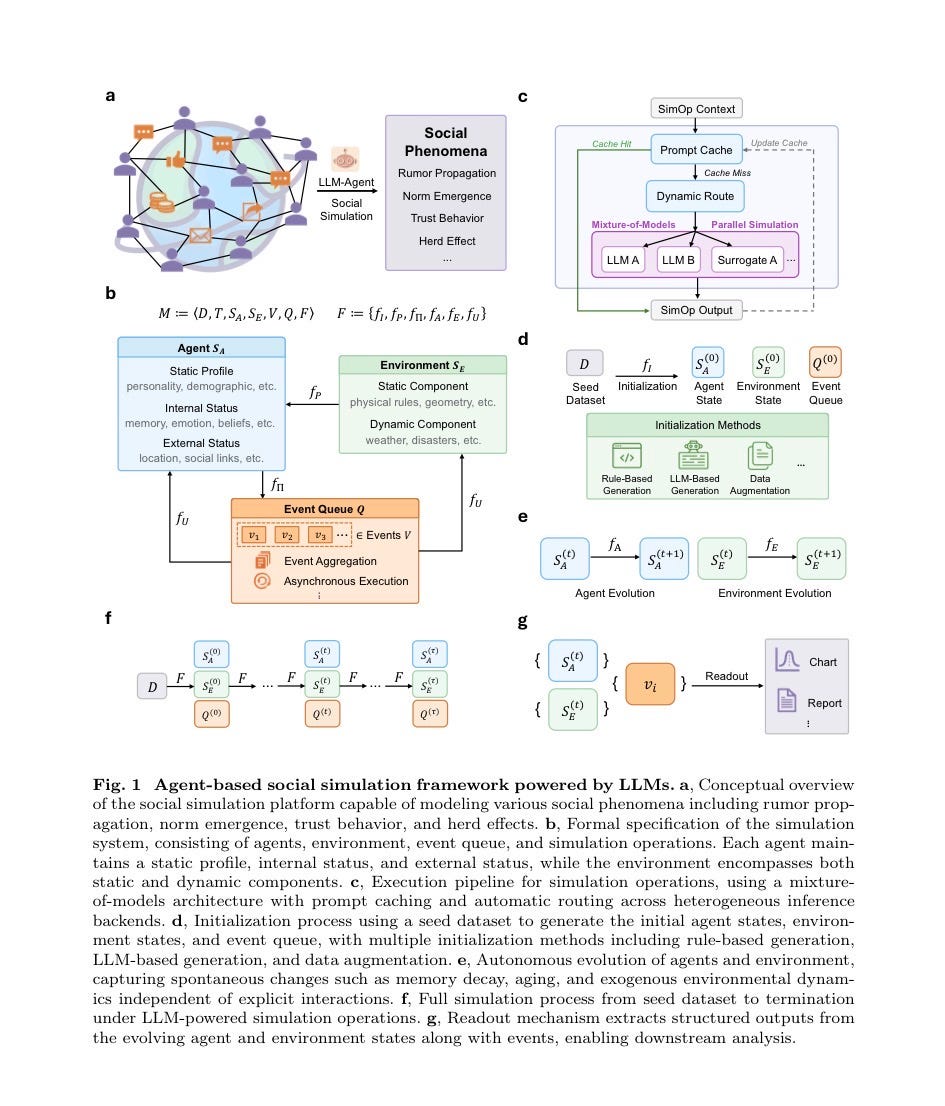
The research, detailed in the paper Modeling Earth-Scale Human-Like Societies with One Billion Agents". It directly addresses longstanding limitations in traditional agent-based models (ABMs), which relied on overly simplified rules, and the computational bottlenecks of pure LLM-driven agents that previously restricted simulations to far smaller populations—typically millions rather than billions.
Bridging High-Fidelity Behavior and Massive Scale
Light Society formalizes social processes as structured transitions of agent and environment states. These transitions are governed by a set of LLM-powered simulation operations dispatched through an efficient event queue. Core components include:
- Agents: Each possesses a static profile (demographics, personality traits drawn from real data), internal cognitive status (memory, evolving beliefs, goals), and external attributes (location, social connections).
- Environment: Combines static elements (spatial layouts, networks) with dynamic ones that evolve during simulation.
- Operations: Initialization, perception, policy/decision-making, evolution (e.g., memory updates), state updates, and readout for analysis.
To achieve unprecedented scale, the framework employs sophisticated optimizations. A **mixture-of-models engine** routes complex interactions to full LLMs while using knowledge-distilled surrogate models (such as multi-layer perceptrons or smaller transformers) for routine updates. Additional techniques include prompt caching, compressed graph representations for social networks, vectorized batch processing, and aggregated event execution.
These innovations reduce computational costs by orders of magnitude without sacrificing behavioral fidelity.
Real-World Data
Agent profiles are instantiated from the World Values Survey (WVS) Wave 7 (2017–2022), using cleaned records of approximately 96,000 respondents. These provide authentic demographic and attitudinal data—age, gender, income, education, social class, values, and more—which are transformed into natural-language personas that condition the agents’ LLM-driven behaviors. This grounding enables more realistic and reproducible experiments than purely synthetic agents.
Key Demonstrations and Findings
The researchers validated Light Society through flagship case studies:
Trust Games: Simulations explored reciprocity and trust dynamics across varying population sizes. Results showed that demographic factors (higher education or social class correlated with greater trust and reciprocity) become sharper and more stable as the number of agents increases. Stochastic noise diminishes at larger scales, revealing clearer scaling laws. In repeated interactions, social norms of trust and reciprocity emerge over time.
Opinion Diffusion at One Billion Agents: On a Barabási–Albert scale-free network with 10⁹ nodes, the team simulated how opinions on topics such as AI-driven unemployment spread from influencers (top 20% of highly connected agents). Key insights included:
- Influencer seeding strategies create asymmetric convergence, with pro- or anti-stances cascading through the network.
- Education and income levels enhance both influence success and resistance to persuasion.
- Linguistic framing (positive vs. negative) modulates the magnitude of stance changes.
- Neutral agents act as buffers, and opinions often shift via cascades rather than direct pairwise influence.
- Surrogate models closely preserved the dynamics of full LLMs, with very low variance across runs.
Additional experiments examined language effects (e.g., Chinese vs. French prompts), network topology influences on polarization, bounded rationality in economic games like the Ultimatum Game, and memory-augmented group discussions that drive consensus even without strong influencers.
Light Society provides researchers with a practical platform for hypothesis testing, counterfactual analysis, and the study of emergent collective behaviors at scales previously unattainable. Potential applications span social science, public policy, information dynamics, epidemic modeling, market simulations, and urban systems.
The authors emphasize that simulation outputs generate hypotheses rather than definitive evidence and must be validated against real-world data, given inherent biases in LLMs and demographic surveys. The framework is modular and extensible, with future work likely focusing on richer long-term memory, multimodal interactions, tighter real-world data integration, and ethical safeguards against potential misuse (such as modeling information operations).
This work represents a major step toward treating entire societies as experimental laboratories in silico.
By combining the nuanced social intelligence of modern LLMs with engineering innovations for extreme scale, Light Society opens new avenues for understanding how individual cognition aggregates into planetary-scale phenomena.
Research paper:
arxiv.org/abs/2506.12078
(PDF: arxiv.org/pdf/2506.12078)