
The Robot Opposable Thumb.
Humanoid Robot Hands.

The rise of advanced robotic end effectors, those subclass of opposable-thumb hands that transform rigid machines into dexterous collaborators.
These are not mere grippers or claws from industrial automation’s past. They are the pinnacle of embodiment: multi-fingered marvels with 12–22 degrees of freedom (DoF), capable of the subtle opposition that lets a thumb meet fingers in precise, adaptive grips.
They bridge the “last centimeter” of true automation the gap between seeing/thinking and touching/doing. While AI brains debate in the cloud, these hands make the physical world theirs.
The Human Blueprint and Robotic Evolution
Human hands are evolutionary masterpieces: 27 bones, over 30 muscles, and an opposable thumb enabling power grips for hammers and precision pinches for needles. The key is opposition—the thumb’s ability to rotate and press against the other fingers, combined with tactile feedback from millions of receptors.
Early robotic end effectors were crude: two-fingered parallel jaws for pick-and-place. Anthropomorphic designs emerged in the late 20th century, but they were bulky, expensive, and limited. Tendon-driven systems mimicked biology by routing cables from remote actuators (reducing hand weight), while direct-drive motors packed power into joints. Both faced trade-offs: tendons introduced friction and stretch; rigid actuators added mass and complexity.11
By the mid-2020s, humanoid robots demanded more. A simple arm with a basic gripper sufficed for repetitive factory work, but household chores, delicate assembly, or unstructured environments required nuance. Enter the dexterous end effector: a subclass prioritizing the opposable thumb for versatile manipulation. These hands integrate sensing, actuation, and control into compact, lightweight forms (often under 800g) that approach human payload and speed.37
Anatomy of an Opposable Thumb Hand
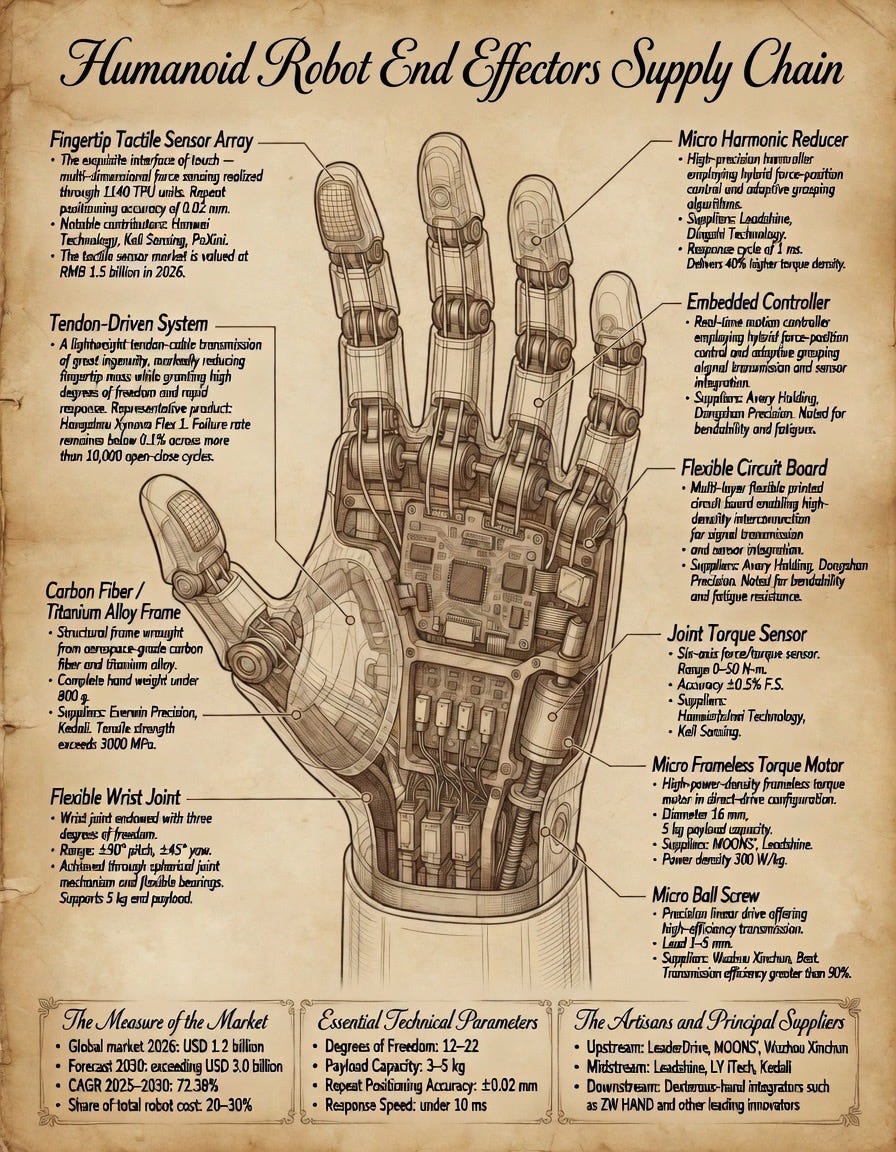
Imagine peering inside one of these marvels, as detailed in the 2026 industry chain diagram:
• Fingertip Tactile Sensor Arrays: Multi-dimensional force sensing (up to 1,140 taxels per fingertip) with 0.02mm repeatability. Suppliers like Hanwei Technology, Keli Sensing, and PaXinni deliver sensitivity down to 0.01N, detecting texture, slip, and temperature. This is the “skin” enabling compliant, damage-free grasping.12
• Tendon-Driven Systems: Lightweight cables reduce distal mass for faster, more fluid motion. Hangzhou Xynova’s Flex series exemplifies reliability, with failure rates under 0.1% over 10,000 cycles. Hybrid designs blend tendons with direct drive for the best of both worlds.31
• Micro Torque Motors and Reducers: Frameless torque motors from MOONS’ and micro harmonic reducers from LeaderDrive provide high power density in tiny packages. Joint torque sensors (0–50 N·m range, ±0.5% accuracy from Hanwei) close the feedback loop for precise force control.29
• Flexible PCBs and Embedded Controllers: High-density interconnects route signals across moving joints. Real-time AI algorithms enable adaptive grasping—learning from experience to adjust grip on fragile eggs or slippery tools.
• Structural Elegance: Carbon fiber/titanium frames keep weight low while maintaining strength. Flexible wrist joints add 3-DoF for natural orientation.
These components form a tightly integrated supply chain, predominantly Chinese in 2026.
Companies like Inspire Robots, LinkerBot, and others ship thousands of units, with crossover players from motors, sensors, and transmission fields accelerating innovation.15
China’s Supply Chain Mastery
The diagram highlights a maturing ecosystem: upstream leaders in reducers (LeaderDrive), motors (MOONS’), and sensors; midstream integrators; downstream humanoid makers. Global dexterous hand market hits ~$1.2 billion in 2026, with a blistering 72% CAGR projected through 2030 though many analysts argue this understates the potential as capabilities scale.0
China’s edge lies in scale, vertical integration, and speed. While Western efforts often emphasize premium software or exotic designs, Chinese firms deliver cost-effective, producible hardware.
This hardware-first approach bolstered by policies like “Made in China 2025” positions them to dominate the physical layer of embodied AI. European and American suppliers still excel in niches, but the volume and iteration pace favor the East.24
The Story Unfolds: From Prototype to Ubiquity
Picture a 2026 factory floor: A humanoid with these end effectors assembles electronics, its thumb and fingers deftly twisting tiny screws without stripping threads, thanks to torque sensing. Or in a home, it folds laundry feeling fabric resistance and adjusting grip on the fly. In medicine, surgical variants perform micro-manipulations beyond human steadiness.
The deeper narrative is intelligence through interaction. As one observer noted, dexterity isn’t just finger movement—l it’s adaptive organizational coordination: sensing, timing, force management, and environmental negotiation all in harmony. These hands don’t just execute commands; they provide rich data back to the “brain,” enabling learning in the physical world. Movement becomes intelligence made manifest.0
Challenges remain: durability under millions of cycles, power efficiency, seamless integration with vision and language models, and ethical questions around labor displacement.
Yet the trajectory is clear. From “to move” to the “new era of usable, easy to use, and durable,” these opposable-thumb end effectors are unlocking the physical world for robots.
In the end, the hand that once defined humanity’s tool-making dominance may now define our silicon successors’ ascent. The fingertips of tomorrow are already grasping it firmly, delicately, and with unstoppable momentum.
Your post confirms the fact that we are embodied in a miracle. Perhaps that's the real goal of AI and robotics: seeking to recreate ourselves as machines.